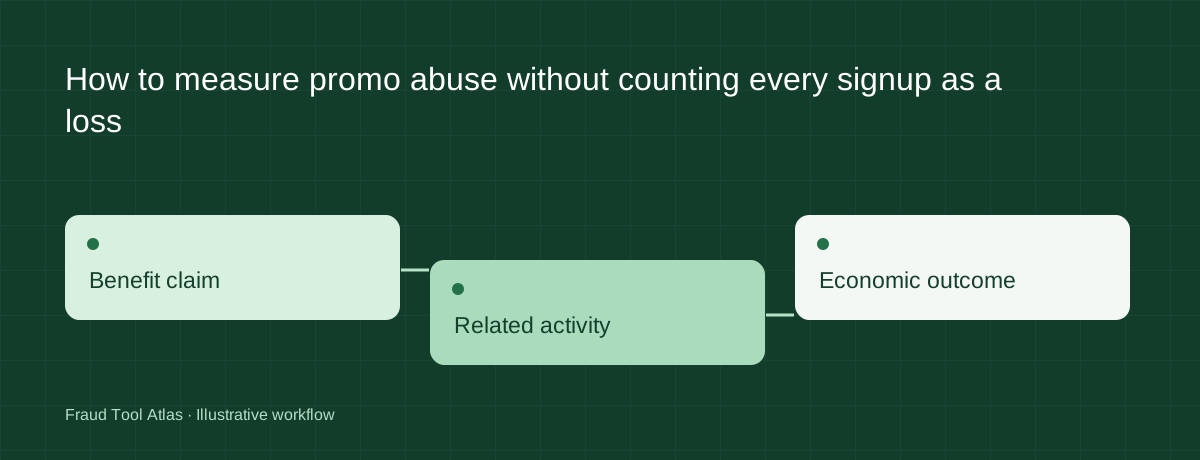
Promo abuse becomes measurable when you count the benefit being claimed. A signup is an event; a paid referral, credit redemption or repeated trial entitlement is an economic outcome. Connect the two before deciding how much a detection tool is worth.
Define who is eligible
State whether the benefit belongs to a person, household, company or subscription. Consider the ordinary exceptions: a shared computer, coworkers, a replacement account or a family using one connection. Support needs the same rule that the risk policy enforces.
Then identify the moment the value leaves your control. Issuing an invitation, creating an account and paying a referral can occur days apart. Place the review where the service can still withhold or adjust the benefit under its published terms.
Create a record for each claim
Keep a benefit ID, account ID, action time, relevant device or session reference and the result of the eligibility check. Add the investigation label later, without replacing the original observation. This preserves the difference between what the detector saw and what the team eventually confirmed.
| Field | Why it matters |
|---|---|
| Benefit and claim ID | Prevents counting the same value twice |
| Account and event time | Places the claim in its journey |
| Device or session reference | Connects relevant activity |
| Eligibility outcome | Records the action taken |
| Confirmed abuse or legitimate appeal | Supports later policy review |
| Actual issued value and review cost | Connects the control to economics |
Use only data appropriate for the service. More fields do not automatically make a stronger conclusion.
Calculate the cost of the control
For an illustrative month, suppose a team confirms that it prevented 100 ineligible redemptions worth 10 US dollars each. That is 1,000 US dollars of avoided issued value under the stated assumptions. It is not automatically 1,000 US dollars of profit: fulfillment costs, customer value and other effects may differ.
Now include the detection fee, investigation effort and compensation or support cost for legitimate customers restricted incorrectly. If the rule prevents a claimed loss but creates more customer harm than it saves, the policy needs adjustment.
Sample the cases the detector allows
Reviewing only flagged accounts can hide missed abuse. Include a small, consistent sample of allowed claims and let outcomes mature for a defined period. Keep “not yet reviewed” distinct from “confirmed legitimate.”
Break results out by the benefit and the user population. A corporate team sharing equipment should not be judged by the same assumption as a consumer offer limited to one person. A drop in registration count alone does not explain whether the control protected the intended value.
Close the loop with support
Give support a short explanation of the rule, the evidence available and the action that can restore eligibility. Track overturned restrictions and feed them into the next policy review. Preserve the original signal even when the decision changes.
The account-abuse category compares tools for these workflows. Use the review questions to test account links and benefit-level evidence before committing to a rollout.
Sources and further reading
Official product and technical sources reviewed October 21, 2026.
FAQ
Should every linked account be rejected?
No. Review the eligibility rule and legitimate shared environments. A technical relationship alone does not establish an abusive claim.
What is the most useful unit?
Measure the protected benefit or redemption, then connect it to account relationships, costs and confirmed outcomes.